The Giant of New Caledonia
The Rhacodactylus Leachianus is an animal capable of leaving a lasting impression thanks to its unique behavior and its imposing yet fascinating presence.
In my breeding project, I try every day to put respect for these animals first by recreating conditions that are as close as possible to their natural needs, while carefully observing the temperament and requirements of each individual and every breeding pair.
To me, keeping Leachianus is not simply about maintaining them in captivity, but about learning to understand an extraordinary species with its own rhythms, habits, and personality.
This guide comes from years of direct experience and is intended to be practical help for anyone wishing to approach these geckos in the right way. I am always open to suggestions and improvements for this guide, since shared experience and constructive contributions from the community can benefit everyone and contribute to better husbandry practices for these animals. I believe the most important thing is to observe, learn, and always put the animal’s well-being above everything else.
Enclosure and setup
Creating a Safe and Functional Environment
One of the most important aspects of keeping Leachianus is providing a stable, safe, and low-stress environment. Over time, I have learned that the simplest solution is often the most effective: well-ventilated plastic tubs with an essential but functional setup allow the animals to live more comfortably while helping maintain stable environmental parameters. Especially during growth, plastic tubs offer several advantages: they retain humidity better, reduce visual stress when opaque, and, equally important, make cleaning much easier. This does not mean sacrificing the gecko’s behavioural well-being.
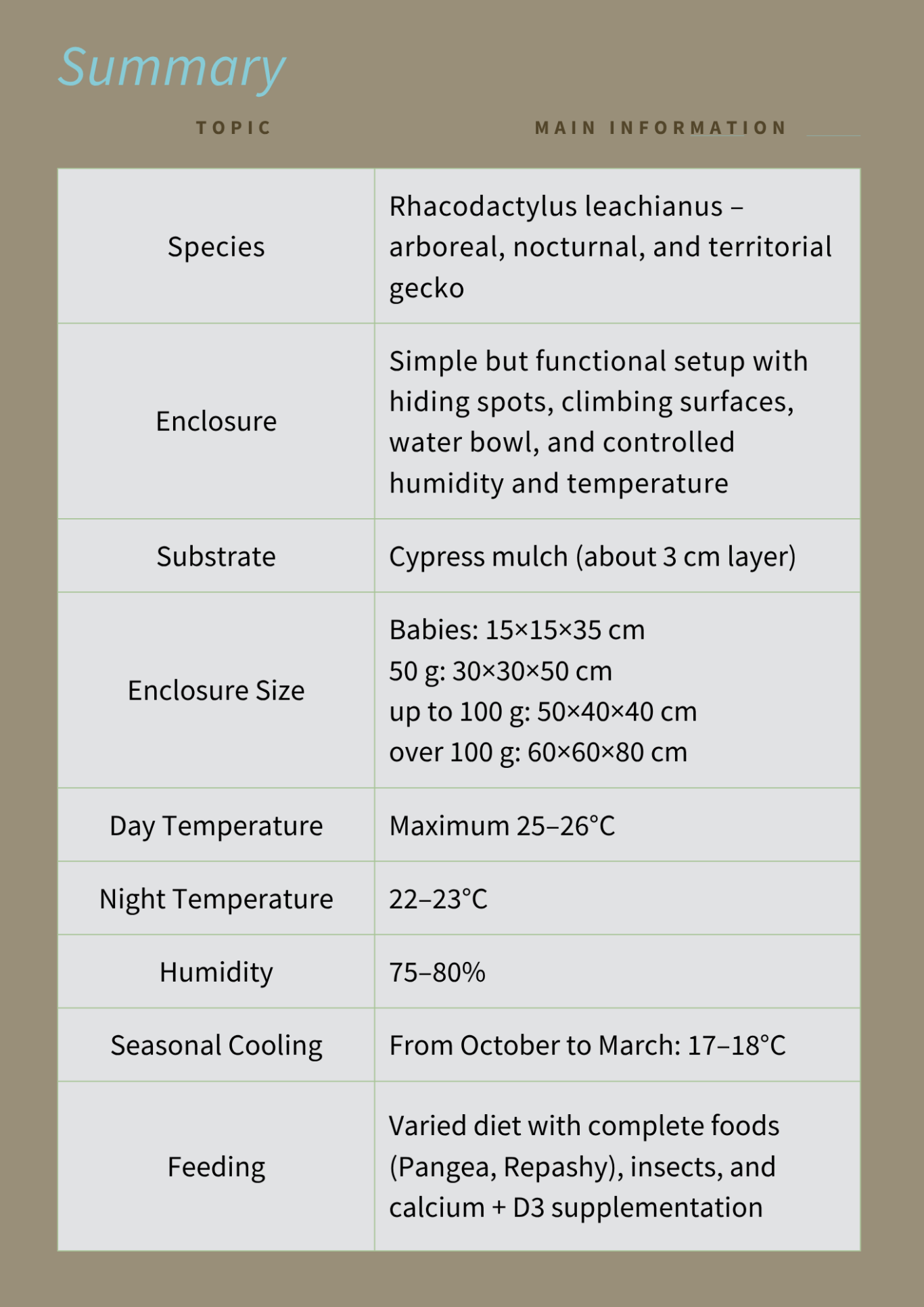
Even in a simple setup, it is very important to provide hiding spots, multiple climbing surfaces, and a humid area. Personally, I use cork bark to create layered climbing structures throughout the entire height of the enclosure, and I leave a large water bowl at the bottom to maintain a more humid zone. I also place a feeding ledge attached to one side of the enclosure for food. As a substrate, I create a layer of about 3 cm on the bottom of the enclosure using cypress mulch.
The size of the enclosures must be proportional to the gecko’s weight and size. Cages that are too small may prevent the animal from moving and climbing properly, while enclosures that are too large — especially for babies — may cause them to stop eating due to fear of predators and stress. Usually, I consider these proportions in cm:
15H*15L*35L for the babies
30H*30L*50L for 50 gr
50H*40L*40L until 100 gr
60H*60L*80L over 100 gr
For the couples, there is no limit, but personally, I use a 80H*80L*100L box
Leachianus are primarily arboreal animals and spend much of their time climbing or hiding. An enclosure that is too bare tends to make them feel insecure and more stressed. To minimize discomfort, I always try to clean enclosures and replace food bowls during the daytime and handle the animals as little as possible. Indeed, the Leachianus species are nocturnal animals, and by interfering with their habitat at night, you would risk stressing the animal.
A Clean Environment Means Healthy Animals.
Consistent cleaning is a form of respect toward the animals we keep. A clean environment allows better monitoring of the animals’ health and reduces the risk of bacterial or parasitic problems. I always try to maintain practical setups that are easy to manage, because simplicity often allows faster intervention and more accurate care.
Temperature and Humidity
One of the most common mistakes is believing that these geckos require very high temperatures. In reality, Leachianus prefers moderate temperatures and can easily suffer from excessive heat.
In my breeding room, I maintain stable temperatures using a dedicated climate-controlled room, with a slight nighttime drop that helps respect their natural rhythm. Humidity also plays a fundamental role, especially in promoting proper sheds and good hydration.
I try to create an environment that is humid but not constantly wet, maintaining a proper balance without excessive stagnant moisture.
As for temperatures, I try never to exceed 25–26°C (77–79°F) during the day and 22–23°C (71–73°F) at night, with humidity levels around 75–80%.
From October to March, I allow my breeding pairs to rest by lowering temperatures to around 17–18°C (62–64°F) in order to encourage a natural seasonal cycling period.
Feeding
A Varied and Balanced Diet
Nutrition is one of the aspects that most influences the growth, health, and reproduction of Leachianus.
In my breeding project, I provide a varied diet, always trying to offer high-quality and well-balanced foods while supplementing with calcium and calcium + D3.
Modern complete diets have proven, in my experience, to be an excellent nutritional base (Pangea, Repashy, etc.).
Every animal is different, however, some individuals strongly prefer insects, while others favor fruitier or creamier foods. Learning to observe these differences helps you better understand your animal.
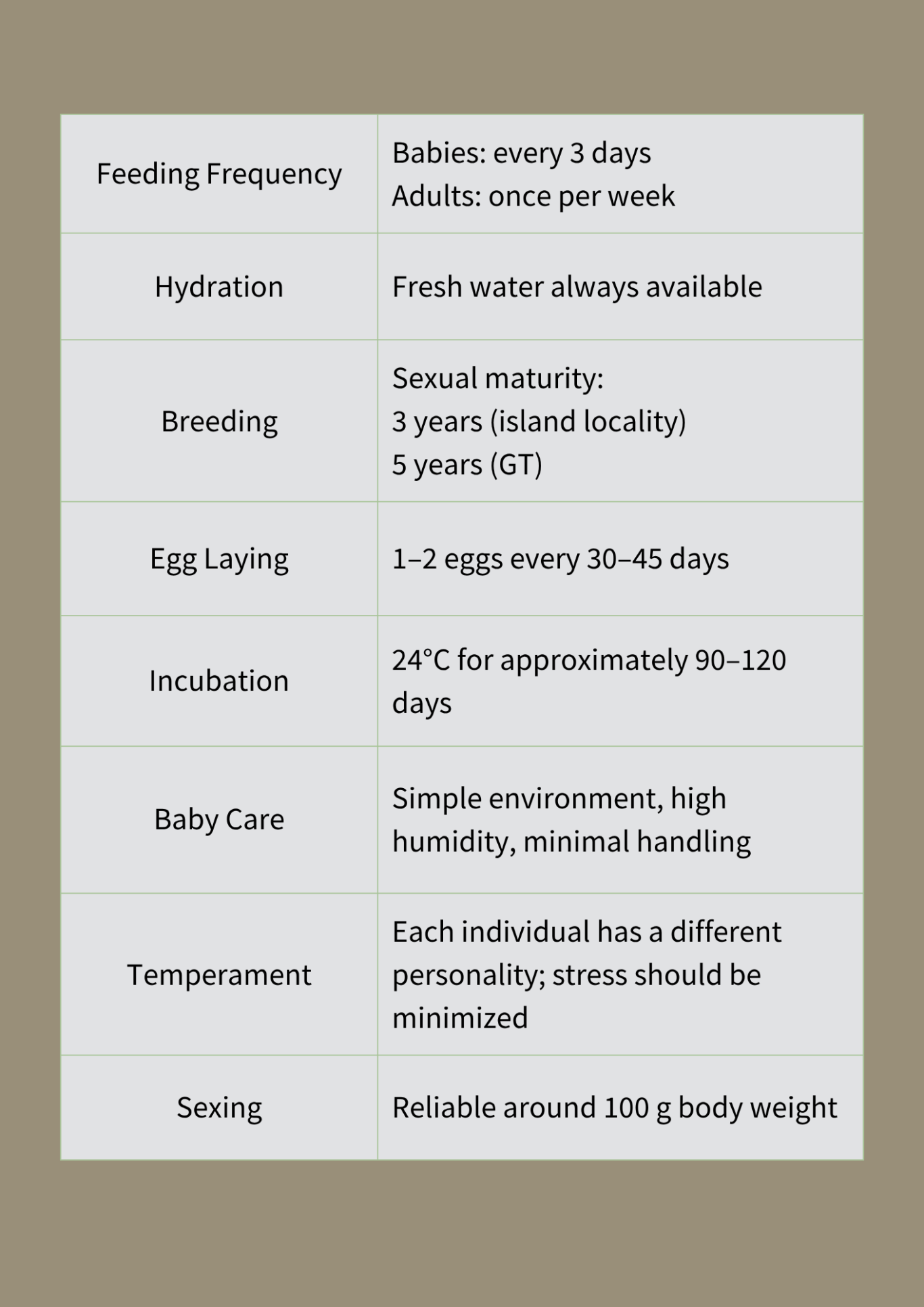
With Leachianus, it is important to avoid excess. Too much food or an unbalanced diet can quickly lead to obesity or metabolic issues. For example, I offer food to babies every three days, while adults are fed once a week. During the summer, appetite and metabolism increase, so I provide larger amounts of food.
I prefer slow but steady growth because animals raised without being pushed too quickly often develop better body structure and more stable long-term health.
Hydration is also fundamental and, as mentioned above, I believe it is very important to always provide the gecko with access to fresh water.
Breeding
Breeding tips
Breeding Leachianus is probably one of the most exciting experiences for a keeper, but it requires great attention and responsibility.
Before pairing animals, I always consider: age, weight, physical condition, and temperament.
Island localities usually become reproductively mature at around three years of age, while GTs reach maturity at about five years old. I try to pair the animals during the coldest period of the year, and before introducing them, I exchange pieces of cork bark between the terrariums so they can get used to the scent of their future tank mate. There should never be any rush. A female bred too early can face serious health problems and intense physical stress. For me, the animals’ health always comes before reproduction.
During the breeding season (from early March until October), I carefully observe the behavior of each animal.
Every pair has different dynamics, and learning to recognize signs of stress or incompatibility is essential. One of the most rewarding parts of breeding is truly getting to know your animals and learning to read behaviors that often go unnoticed. Good signs are when the pair sleeps inside the same cork bark and eats from the same bowl while remaining in contact with each other. During mating, scars and minor signs of fighting are normal; the important thing is to pay attention when these wounds become too deep or when one of the two shows clear bullying behavior toward the other. For example, if one animal stays at the top of the enclosure while the other remains hidden under the substrate, it is a clear sign that the two are not compatible and should be separated.
If the pair is compatible and mates successfully, a clutch of one or two eggs — two being the norm — is generally expected every 30–45 days. It is always necessary to provide a container filled with moist coconut fiber for egg laying. A sign that egg deposition is imminent is when the female begins digging inside the laying box. Once the eggs are laid, it is best to remove them from the terrarium and incubate them properly. There are several possible methods; personally, I use small ventilated containers with two tiny holes and perlite mixed with water at a 1:1 ratio. The eggs should be incubated fresh. I prefer to let the embryo develop slowly, so I incubate them at around 24°C. At this temperature, the eggs usually hatch after approximately 90–120 days. If the eggs need to be handled to rehydrate the perlite or for any other reason, it is important to avoid turning them upside down, as this may damage the developing embryo.
Raising Babies
Hatchlings are special every single time.
Baby Leachianus are managed carefully from their very first days, with attention focused on providing calm environments, proper humidity, and adequate feeding without forcing growth. Once hatched, it is best to leave the gecko undisturbed for several hours and allow it to absorb the yolk sac. This provides the first nutrients necessary for its first days of life. After the yolk sac has been fully absorbed, the gecko can be moved into a small plastic container with well-moistened paper towels to help it complete its first shed safely, along with a small water dish and a few hiding spots. It is important to keep things simple during this early stage of the gecko’s life.
Temperament and Behavior
Every Leachianus Has a Different Personality
One of the things I love most about this species is the strong individuality of each animal.
Some Leachianus are calm and tolerate the keeper’s presence well, while others remain more territorial and cautious. Over time, many individuals learn to recognize routines and become more confident, but I believe it is always important to respect their limits and never force interaction. Leachianus communicate far more than many people realize. Vocalizations, postures, and behaviors often reflect the animal’s emotional state.
Their vocalizations are certainly one of the most iconic characteristics of the species.
Sexing
Sexing young animals requires experience and patience.
As they grow, differences become increasingly visible, especially in males, which develop more pronounced pre-anal pores and hemipenal bulges, generally located beneath the tail on the underside of the body, forming a V-shaped pattern between the hind legs.
I always prefer to avoid rushing the sexing process, especially with very young babies, because proper identification requires time and adequate development. Determining the sex of females can be particularly challenging, as they may occasionally exhibit pseudo-pores or lightly developed pores that can be confused with those of males. Sexing can usually be considered reliable once the animal reaches a weight of approximately 100g, although in many cases it becomes apparent earlier, especially in males.